Toolkit guide
Topic
Promising practice - integrated multidisciplinary model, addresses fragmentation, intersectoral.
Tools & Frameworks
Good practice
Language
EN
Use it to…
Use it to help identify, adapt, and apply effective solutions for flexible, community-based treatment for young people with complex needs.
Where to look in this resource
The whole document is relevant - it summarises the main characteristics of the practice.
Image
Flexible Assertive Community Treatment (Youth F-ACT)
Setting
Area
2.2
Description

Youth F-ACT embeds multidisciplinary teams (psychiatrists, nurses, psychologists, employment and addiction specialists, peer support and social workers, family therapists) within the community to support young people with severe conditions and complex needs across education, employment, relationships, family, housing and finances.

Brief description
Community-based flexible assertive treatment for complex needs (Netherlands).
Country
Netherlands 
Keywords
assertive community treatment, multidisciplinary, addresses fragmentation, intersectoral
Resource Title
Flexible Assertive Community Treatment (Youth F-ACT)
Topic
Promising practice - community-based, low-threshold, subclinical support.
Tools & Frameworks
Good practice
Language
EN
Use it to…
Use it to help identify, adapt, and apply effective solutions for community-rooted subclinical mental health support.
Where to look in this resource
The whole document is relevant - it summarises the main characteristics of the practice.
Image
Mindspace Mayo
Setting
Area
2.2
Description

A community-based service in County Mayo providing accessible mental health support and counselling to young people, working closely with local services.

Brief description
Community-based youth mental health support (Ireland).
Country
Ireland
Keywords
low-threshold, subclinical support, community-based, Ireland
Resource Title
Mindspace Mayo
Topic
Promising practice - migrant/refugee priority focus, trauma-focused, evidence in target group.
Tools & Frameworks
Good practice
Language
EN
Use it to…
Use it to help identify, adapt, and apply effective solutions for trauma-recovery support for children with migration or refugee backgrounds.
Where to look in this resource
The whole document is relevant - it summarises the main characteristics of the practice.
Image
Teaching Recovery Techniques (TRT)
Setting
Area
2.2
Description

A skills-based group intervention designed for humanitarian settings; evaluated in Sweden with unaccompanied refugee minors, where it showed significant improvements in PTSD and depression symptoms.

Brief description
Skills-based trauma-recovery intervention for humanitarian settings.
Country
Sweden 
Keywords
migrant & refugee, trauma-focused, targeted prevention, evidence in target group
Resource Title
Teaching Recovery Techniques (TRT)
Topic
Promising practice - low-threshold, free, dedicated subclinical model, evidence-based.
Tools & Frameworks
Good practice
Language
EN
Use it to…
Use it to help identify, adapt, and apply effective solutions for low-threshold subclinical care bridging prevention and specialist services.
Where to look in this resource
The whole document is relevant - it summarises the main characteristics of the practice.
Image
Prompt Mental Health Care (PMHC)
Setting
Area
2.2
Description

A dedicated subclinical model offering low-threshold, free-of-charge access to care for people with mild-to-moderate anxiety, depression, sleep problems or early-stage substance-use issues, currently for older adolescents (16+) and adults.

Brief description
Low-threshold, free subclinical care for mild-to-moderate difficulties (Norway).
Country
Norway 
Keywords
low-threshold, free access, subclinical model, evidence-based
Resource Title
Prompt Mental Health Care (PMHC)
Topic
Innovative practice (*) - migrant/refugee priority, integrated and culturally sensitive care.
Tools & Frameworks
Innovative practice
Language
EN
Use it to…
Use it to help identify, adapt, and apply effective solutions for integrated, culturally sensitive care for asylum-seeking and refugee children.
Where to look in this resource
The whole document is relevant - it summarises the main characteristics of the practice.
Image
SAMIFO – Health Centre for Asylum Seekers and Refugees *
Setting
Area
2.2
Description

A health centre (within ASL Roma 1) providing integrated mental and physical health care to forced migrants through a multidisciplinary, culturally sensitive approach.

Brief description
Integrated health service for asylum seekers and refugees (Rome, Italy).
Country
Italy
Keywords
migrant & refugee, culturally sensitive, integrated care, innovative practice, Asylum seekers
Resource Title
SAMIFO – Health Centre for Asylum Seekers and Refugees *
Topic
Promising practice - scalable digital CBT, free/embedded in care, multilingual transfer.
Tools & Frameworks
Good practice
Language
EN
Use it to…
Use it to help identify, adapt, and apply effective solutions for accessible web-based self-help for mild-to-moderate depression.
Where to look in this resource
The whole document is relevant - it summarises the main characteristics of the practice.
Image
I Fight Depression
Area
2.2
Description

A web-based, guided self-help tool grounded in cognitive-behavioural therapy principles, with a dedicated section for young people. It is part of routine care in Germany (free of charge), translated into multiple languages and available across several European countries.

Brief description
Web-based CBT self-help tool for mild-to-moderate depression.
Country
Bulgaria, Estonia, Germany, Greece, Hungary, Ireland, Italy, Poland, Spain 
Keywords
digital CBT, cognitive-behavioural therapy, depression, self help
Resource Title
I Fight Depression

Topic
Promising practice - digital, peer-based, promotion/universal prevention.
Tools & Frameworks
Good practice
Language
EN
Use it to…
Use it to help identify, adapt, and apply effective solutions for digital peer-learning platforms for youth mental health.
Where to look in this resource
The whole document is relevant - it summarises the main characteristics of the practice.
Image
Peerlearning.net
Area
2.2
Description

An online peer-learning platform supporting mental health promotion and prevention among young people through digital resources and peer engagement.

Brief description
Digital peer-learning platform for mental health (Italy).
Country
Italy 
Keywords
peer-based, digital, promotion, universal prevention
Resource Title
Peerlearning.net
Topic
Promising practice - digital/game-based, anxiety-focused, scalable.
Tools & Frameworks
Good practice
Language
EN
Use it to…
Use it to help identify, adapt, and apply effective solutions for engaging digital self-help tools for childhood anxiety.
Where to look in this resource
The whole document is relevant - it summarises the main characteristics of the practice.
Image
Lumi Nova
Area
2.2
Description

A therapeutic mobile game (digital intervention) that helps children manage fears and anxiety using evidence-based techniques delivered through gameplay.

Brief description
Therapeutic mobile game for childhood anxiety (UK).
Country
UK 
Keywords
game-based, anxiety, digital, scalable, subclinical care
Resource Title
Lumi Nova
Topic
Innovative practice (*) - digital, research-stage, universal prevention.
Tools & Frameworks
Innovative practice
Language
EN
Use it to…
Use it to help identify, adapt, and apply effective solutions for innovative digital interventions in youth mental health.
Where to look in this resource
The whole document is relevant - it summarises the main characteristics of the practice.
Image
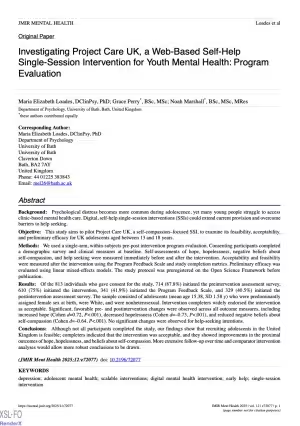
Project Care UK *
Area
2.2
Description

A digital mental health intervention for young people, documented in peer-reviewed research, addressing prevention/early support through an online format.

Brief description
Digital mental health intervention (UK).
Country
UK
Keywords
digital, research-stage, universal prevention, innovative practice
Resource Title
Project Care UK *
Topic
Innovative practice (*) - widely adopted multilingual digital tool; evaluation limited.
Tools & Frameworks
Innovative practice
Language
EN
Use it to…
Use it to help identify, adapt, and apply effective solutions for scalable digital self-help tools for young people.
Where to look in this resource
The whole document is relevant - it summarises the main characteristics of the practice.
Image
Nepanikar
Area
2.2
Description

An app-based tool developed in the Czech Republic, designed primarily for young people, offering support across anxiety, eating disorders and crisis situations, plus courses and training on prevention and crisis intervention. It is available in 18 languages and adopted across several European countries.

Brief description
Mental health self-help app for young people (Czechia).
Country
Czechia, Germany, Estonia, Finland, France, Italia, Norway, Poland, Portugal, Slovakia, Slovenia 
Keywords
multilingual, digital tool, widely adopted, evaluation limited
Pdf file
77_Nepanikar.pdf (378.01 KB)
Resource Title
Nepanikar *