Toolkit guide
Source
WHO Regional Office for Europe, 2023
Topic
Immunisation; Migrant health; Legal entitlement
Tools & Frameworks
Strategies
Language
EN
Relevant actions
1.2 (framework review) · 2.2 L3 actions
Use it to…
Align national frameworks on vaccination access for refugees and migrants.
Where to look in this resource
The pillar on universal health coverage, which carries the commitments on catch-up vaccination on arrival regardless of legal status.
Image
Action Plan for Refugee and Migrant Health in the WHO European Region 2023–2030
Health Area
Area
Response
Description

This Action Plan, adopted by the 53 Member States of the WHO European Region in 2023, provides the strategic framework for refugee and migrant health across the Region through 2030. It is structured around five pillars: universal health coverage for refugees and migrants; financial protection; health system responsiveness to the needs of refugees and migrants; strengthening the health workforce; and improving information systems. The universal health coverage pillar explicitly addresses vaccination as a core entitlement, and the plan includes specific actions on immunisation including catch-up vaccination at arrival, multilingual information, and integration of vaccination into primary care services accessible to refugees and migrants regardless of their legal status.

Brief description
WHO Europe action plan adopted by 53 Member States defining five strategic pillars including universal health coverage for refugees and migrants.
Keywords
refugee health; migrant health; catch-up vaccination; universal health coverage; legal status; WHO Europe; action plan
Resource Title
Action Plan for Refugee and Migrant Health in the WHO European Region 2023–2030 [2.2]
Policy lever
L3
Source
UNICEF, 2025
Topic
Immunisation; Multisectoral coordination; Equity
Tools & Frameworks
Tools & Frameworks
Language
EN
Relevant actions
Action 1
Use it to…
Structure cross-ministry coordination and named contact points.
Where to look in this resource
Phase 2, Stage 1 sets up the multisectoral coordination framework; Phase 3 covers collaborative action and Phase 4 adaptive monitoring. The contents page maps the four phases.
Image
UNICEF Multisectoral approaches to reach zero-dose and underimmunized children: operational guidance
Health Area
Area
Response
Description

This UNICEF operational guidance, published in 2025, sets out the framework for establishing and sustaining multisectoral coordination on immunisation equity. It addresses four principal themes: (1) governance models for inter-ministerial coordination between health, education, social affairs, justice, interior, and migration, with practical templates for mandates, named focal points, and meeting cadences; (2) data-sharing agreements that allow disaggregated immunisation data to flow between ministries while respecting GDPR and national data protection law; (3) institutional recognition of the wider 'Professionals for Health' workforce — community health mediators, school nurses, cultural brokers, reception centre staff, peer educators in detention — within national health workforce frameworks, including accredited training, salary scales, and career pathways; and (4) case studies from countries where multisectoral architectures have survived beyond individual political champions.

Brief description
UNICEF HQ operational guidance (2025) providing the framework for cross-ministry coordination on immunisation equity, including governance models, data-sharing arrangements, and recognition of the wider workforce.
Keywords
multisectoral; cross-sectoral coordination; governance; workforce recognition; zero-dose; operational guidance; UNICEF
Resource Title
UNICEF Multisectoral approaches to reach zero-dose and underimmunized children: operational guidance [2.3]
Policy lever
Policy area 2 – Establish cross-sectoral coordination
Source
Council of the European Union, 2024
Topic
Immunisation; EU policy; Financing
Tools & Frameworks
Strategies
Language
EN
Relevant actions
1.2 (framework review) · 2.2 L1 actions
Use it to…
Reference the EU-level call for greater investment in prevention.
Where to look in this resource
The paragraphs on investment in prevention and disease prevention as core public health infrastructure — the text to quote in a finance dialogue.
Image
EU Council Conclusions on the Future of the European Health Union
Health Area
Area
Response
Description

These Council Conclusions, adopted in 2024, represent the EU's most recent high-level political statement on the direction of the European Health Union. They call explicitly for increased investment in prevention and disease prevention, framing prevention not as a campaign budget line but as core public health infrastructure. The Conclusions emphasise the importance of addressing health inequalities across Member States and within them, supporting vulnerable populations, and strengthening cross-border cooperation on health threats including vaccine-preventable diseases. They build on earlier EU commitments in the European Health Data Space, the Pharmaceutical Strategy for Europe, and the work of HERA.

Brief description
2024 Council Conclusions explicitly calling for increased investment in prevention and disease prevention as core public health infrastructure.
Keywords
Council Conclusions; European Health Union; prevention investment; health financing; EU policy
Resource Title
EU Council Conclusions on the Future of the European Health Union [1.2]
Source
Maassen et al., Lancet Primary Care, 2025
Topic
Immunisation; Equity; Structural barriers
Tools & Frameworks
Studies and reports
Language
EN
Relevant actions
2.2 (all three levers)
Use it to…
Review the synthesis of EU project evidence behind the three levers.
Where to look in this resource
The synthesis section drawing RIVER-EU, AcToVax4NAM and RISE-Vac findings together, which sets out the structural argument behind the three levers.
Image
Why are Europe's underserved still unprotected? A call to address structural barriers to immunisation
Health Area
Area
Response
Description

This 2025 article in Lancet Primary Care, by Maassen and colleagues, synthesises findings from three major EU-funded projects — RIVER-EU, AcToVax4NAM, and RISE-Vac — to make the case that vaccination inequity in Europe is shaped primarily by structural rather than operational factors. The article documents the recurring pattern of promising practices that fail to institutionalise beyond project funding, and argues that addressing this pattern requires attention to the upstream policy environment rather than additional operational interventions. It introduces the 'Professionals for Health' (PFH) concept, which describes the wider workforce of community health mediators, school nurses, cultural brokers, reception centre staff, and peer educators in detention whose sustained existence depends on coordinated action across financing, governance, and legal entitlement.

Brief description
Maassen et al. (Lancet Primary Care 2025) -synthesis of findings from RIVER-EU, AcToVax4NAM, and RISE-Vac proposing the 'Professionals for Health' concept.
Keywords
structural barriers; underserved populations; policy levers; Lancet; call to action; immunisation equity
Resource Title
Why are Europe's underserved still unprotected? A call to address structural barriers to immunisation [2.2]
Policy lever
L1–L3
Source
ECDC, 2026
Topic
Immunisation; HPV; Cancer prevention; Monitoring
Tools & Frameworks
Studies and reports
Language
EN
Relevant actions
1.1 Action 1 · 1.3 (HPV objectives)
Use it to…
Set HPV objectives against the Council Recommendation.
Where to look in this resource
The country tables on programme characteristics and the coverage-by-age-15 annexes, for setting national HPV objectives against the Council Recommendation.
Image
ECDC The State of Health of HPV vaccination programmes in the EU/EEA
Health Area
Area
Context
Description

ECDC surveillance and monitoring report on the status of HPV vaccination programmes across the EU/EEA, accompanying the first release of the EU vaccination coverage dashboard. It monitors the policy objectives set out in the EU Council Recommendation on vaccine-preventable cancers, adopted by EU health ministers in June 2024, which calls on ECDC to monitor the performance of HPV vaccination programmes and to track Member State progress towards 90% coverage among girls in eligible cohorts and significantly increased vaccination of boys. The report describes the performance of HPV vaccination programmes and synthesises evidence to inform policy actions to strengthen them. Data are drawn from the Global Cancer Observatory, an ECDC survey of National Focal Points for vaccine-preventable diseases complemented by desk review, the WHO Immunisation Data Portal, and rapid literature reviews. It covers the burden of HPV infection and HPV-related cancers, vaccination policies and programme design, delivery models, coverage by age 15 in girls for first and last dose over 2020-24, catch-up programmes, and vaccination acceptance and strategies to increase uptake. As of 2025 all EU/EEA countries recommend HPV vaccination for both adolescent girls and boys, with primary vaccination ages ranging from nine to 13 years and the 9-valent product recommended exclusively in 23 countries. No EU/EEA country had met the WHO cervical cancer elimination target of an incidence below 4 per 100 000 as of 2022. The report closes with recommended public health actions to strengthen HPV vaccination programmes.

Brief description
ECDC (2026) report on the status of HPV vaccination programs across the EU/EEA, covering policies, delivery models and coverage, monitoring the Council Recommendation on vaccine-preventable cancers.
Keywords
HPV; cervical cancer; adolescent girls; boys; coverage dashboard; catch-up; ECDC
Resource Title
ECDC The State of Health of HPV vaccination programmes in the EU/EEA [1.3]
Source
WHO Regional Office for Europe
Topic
Immunisation; Strategic framework
Tools & Frameworks
Strategies
Language
EN
Relevant actions
1.2 (framework review) · 1.3 (objective setting)
Use it to…
Anchor national objectives in the shared regional framework.
Where to look in this resource
The regional goals and targets, and the equity and zero-dose commitments, which give national objectives a shared reference point.
Image
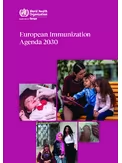
European Immunisation Agenda 2030
Health Area
Area
Context
Description

The European Immunization Agenda 2030 (EIA 2030) is the regional translation of the global Immunization Agenda 2030 framework, adopted by all 53 Member States of the WHO European Region. It articulates a vision of life-course immunisation in which every person is protected against vaccine-preventable diseases regardless of where they live, how they earn a living, or what legal status they hold. The Agenda sets explicit equity commitments including: reducing inequities in coverage between and within countries; strengthening primary health care as the foundation for immunisation delivery; integrating immunisation with other primary care services across the life course; and building sustainable financing for immunisation programmes. It includes specific 2030 targets for HPV coverage, measles elimination, and reduction of zero-dose children.

Brief description
Joint WHO Europe, Gavi, and UNICEF strategic framework with explicit equity and life-course commitments, adopted by all 53 Member States of the WHO European Region.
Keywords
EIA 2030; immunisation agenda; regional framework; coverage targets; zero-dose; life course; WHO Europe
Resource Title
European Immunisation Agenda 2030 [1.3]
Source
ECDC, 2025
Topic
Immunisation; Measles; Monitoring
Tools & Frameworks
Studies and reports
Language
EN
Relevant actions
Action 1
Use it to…
Document outbreak patterns and their link to local coverage gaps.
Where to look in this resource
The country case counts and the breakdown by vaccination status, which show where outbreaks track local coverage gaps.
Image
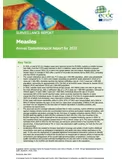
ECDC Measles Annual Epidemiological Report 2024
Health Area
Area
Context
Description

This ECDC Annual Epidemiological Report for 2024 documents the resurgence of measles across the EU/EEA, with over 35,000 cases reported — a tenfold increase on 2023. The report provides country-by-country case counts, analysis of affected age groups, the proportion of hospitalisations and deaths, and the link between local coverage gaps and outbreak clusters. It also reviews the relationship between the surge and broader trends in vaccine confidence and access across Europe. The data is used by Member States, the European Commission, and WHO Europe as the authoritative reference for measles epidemiology in the Region.

Brief description
ECDC annual report documenting the tenfold surge in measles cases across the EU/EEA in 2024, with geographic and demographic breakdown.
Keywords
measles; outbreak; surveillance; epidemiological report; notification rate; ECDC; 2024
Resource Title
ECDC Measles Annual Epidemiological Report 2024 [1.1]
Source
UNICEF, 2025
Topic
Health systems; Methodology; Children's health
Tools & Frameworks
Tools & Frameworks
Language
EN
Relevant actions
Response (framing the three levers)
Use it to…
Frame the three levers as one system rather than a list of parallel issues.
Where to look in this resource
The problem-framing steps, which are the part that transfers to policy level; the worked examples are programme-level.
Image
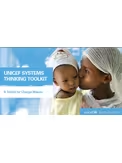
UNICEF Systems Thinking Toolkit for Change Makers
Health Area
Area
2.2
Description

The UNICEF Systems Thinking Toolkit is a practical, beginner-friendly guide that introduces systems thinking as a structured, iterative process for understanding complex challenges that affect children's health and wellbeing. It is designed for practitioners who are not systems-thinking specialists and walks through: (1) framing a problem in systems terms; (2) mapping actors, interventions, and feedback dynamics; (3) identifying leverage points where upstream action produces the largest downstream effects; (4) engaging stakeholders in co-developing systems maps; and (5) tracking the evolution of a system over time. The toolkit is operational rather than purely theoretical, and includes worked examples from child health and social policy contexts.

Brief description
UNICEF (2025) practical guide introducing systems thinking as an iterative process for understanding complex health and social challenges affecting children.
Keywords
systems thinking; systems change; health system strengthening; methodology; toolkit; UNICEF
Resource Title
UNICEF Systems Thinking Toolkit for Change Makers [2.2]
Policy lever
L1–L3
Source
UNICEF ECARO
Topic
Immunisation; Equity; Legal status
Tools & Frameworks
Tools & Frameworks
Language
EN
Relevant actions
Actions 1 and 2
Use it to…
Identify where legal and administrative barriers exclude specific populations.
Where to look in this resource
The diagnostic steps for identifying populations excluded by legal or administrative status, and the prioritisation logic that ranks areas by absolute numbers of missed children rather than by percentages.
Image
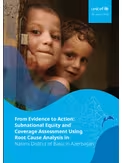
UNICEF Equity and Coverage Assessment
Health Area
Area
1.1
Description

The Equity and Coverage Assessment is a diagnostic framework from UNICEF ECARO. It provides a structured methodology for identifying populations that are excluded from immunisation services by legal or administrative requirements, including irregular residency status, insurance gates, identification number requirements, and fee-for-service arrangements. The assessment methodology covers: (1) mapping of the legal entitlement framework to vaccination for different populations, with particular attention to migrants, refugees, asylum seekers, undocumented people, and people in detention; (2) identification of administrative gates that exclude populations even where the legal entitlement formally exists; (3) analysis of catch-up provisions for newcomers and people with incomplete vaccination histories; and (4) specific policy reforms needed to close the gaps identified. The framework is designed to feed directly into national legislative and administrative reform processes.

Brief description
UNICEF ECARO diagnostic framework for identifying where legal and administrative barriers exclude specific populations from vaccination, and what policy reforms are needed to remove them.
Keywords
equity assessment; coverage assessment; legal barriers; administrative barriers; entitlement; diagnostic; UNICEF ECARO
Resource Title
UNICEF Equity and Coverage Assessment [1.1]
Policy lever
Policy area 3 – Clarify universal access to vaccination

Source
Evidence report, Annex A, practice sheet 10 (innovative practice)
Topic
Health-centre access + communication · Migrants and uninsured
Tools & Frameworks
Best practices
Language
EN
Relevant actions
Step 2.2, L3 action 3 · Step 3.1, Action 3
Use it to…
Open a parallel access route for people who hold an entitlement but cannot use the standard registration pathway.
Where to look in this resource
Page 1 describes the parallel public-health-centre route alongside the GHS and the targeted communication that makes it known; page 2 records the assessment.
Image
Cyprus — Public health centres and targeted communication for migrants and uninsured
Health Area
Area
2.2
Description

Cyprus introduced its General Healthcare System in 2019–2020, providing universal healthcare coverage to legal residents. People outside that system — newly arrived migrants pending registration, irregular migrants and uninsured individuals — may face access barriers to routine immunisation despite the formal entitlement of all children. Vaccination is therefore delivered through public health centres in parallel to the GHS GP-registered route, supported by targeted communication campaigns informing migrant and uninsured populations of the access pathways available to them. Cyprus also participates in two EU projects on vaccination of underserved populations, RISE-Vac and AcToVax4NAM. Delivered by the Ministry of Health with the State Health Services Organisation, public health centres and NGO partners. Assessed as an innovative practice; Sustainability met, Intersectoral collaboration partially met.

Brief description
Parallel public-health-centre access route plus targeted migrant communication.
Keywords
Cyprus; public health centres; uninsured; migrants; targeted communication; parallel access route
Resource Title
Cyprus — Public health centres and targeted communication for migrants and uninsured [2.2]
Policy lever
L3 (lead), L1
Lead policy lever
Policy area 3 – Clarify universal access to vaccination