Toolkit guide
Source
EU-JAV consortium (20 EU Member States)
Topic
Immunisation; EU cooperation
Tools & Frameworks
Best practices
Language
EN
Relevant actions
Action 1
Use it to…
Benchmark national programme arrangements against peers across Member States.
Where to look in this resource
The work-package outputs on immunisation information systems, on vaccine supply and preparedness, and on hesitancy and uptake, for benchmarking national arrangements.
Image
EU-JAV β€” EU Joint Action on Vaccination
Health Area
Area
2.1
Description

EU-JAV was the EU Joint Action on Vaccination, a multi-country project involving 20 EU Member States that ran 2018–22 with the aim of strengthening cooperation against vaccine-preventable diseases. Its work covered four main areas: improving vaccine supply and availability; addressing vaccine hesitancy; supporting electronic immunisation information systems; and developing the research agenda for vaccines and vaccination. The project produced comparative analyses of Member State vaccination programmes, policy recommendations on vaccine supply and hesitancy, and the technical groundwork for the EU's subsequent work on vaccination cooperation. EU-JAV's outputs informed the 2018 Council Recommendation on strengthened cooperation against vaccine-preventable diseases.

Brief description
Joint Action involving 20 EU Member States to strengthen cooperation against vaccine-preventable diseases, address hesitancy, and improve vaccine supply.
Keywords
EU-JAV; joint action on vaccination; national immunisation programmes; EU cooperation; supply; benchmarking
Resource Title
EU-JAV β€” EU Joint Action on Vaccination [2.1]
Source
IMMUNION consortium (EU-funded)
Topic
Immunisation; Capacity building
Tools & Frameworks
Best practices
Language
EN
Relevant actions
3.1 Action 2
Use it to…
Access health-professional training and coalition-building materials.
Where to look in this resource
The health-professional training and the coalition-building materials.
Image
IMMUNION β€” Strengthening immunisation capacity and literacy across the EU
Health Area
Area
3.1
Description

IMMUNION is an EU-funded project that builds vaccination capacity, vaccine literacy, and stakeholder coordination across EU Member States. Its work covers healthcare professional training, public communication, stakeholder engagement, and cross-country knowledge exchange. The project produces training materials and maintains networks that connect national vaccination programmes with civil society, patient organisations, and academic institutions. IMMUNION complements the more population-specific projects (RIVER-EU, AcToVax4NAM, RISE-Vac) by addressing the broader capacity base on which all immunisation equity work depends.

Brief description
EU project building vaccination capacity, vaccine literacy, and stakeholder coordination across Member States.
Keywords
IMMUNION; immunisation literacy; capacity building; health workforce; coalition; EU project
Resource Title
IMMUNION β€” Strengthening immunisation capacity and literacy across the EU [3.1]
Source
VAX-TRUST consortium (EU-funded)
Topic
Immunisation; Vaccine hesitancy; Trust
Tools & Frameworks
Best practices
Language
EN
Relevant actions
3.1 Actions 1–3
Use it to…
Understand trust, continuity of care and clarity of entitlement as the drivers behind recorded hesitancy.
Where to look in this resource
The findings on trust, continuity of care and clarity of entitlement as the drivers behind what is usually recorded as hesitancy.
Image
VAX-TRUST β€” Addressing vaccine hesitancy in Europe
Health Area
Area
3.1
Description

VAX-TRUST is an EU-funded project that investigates the social, cultural, and institutional determinants of vaccine hesitancy across multiple European contexts. Rather than treating hesitancy as a uniform attitudinal phenomenon, the project explores how hesitancy is shaped by trust in institutions, experiences of discrimination, local histories of public health interventions, and the continuity (or discontinuity) of the clinical encounter. The project produces country case studies, comparative analyses, and recommendations for building trust-based approaches to vaccination that address the upstream conditions in which hesitancy emerges rather than treating it as an isolated individual-level problem.

Brief description
Multi-country EU project examining the social, cultural, and institutional determinants of vaccine hesitancy across European contexts.
Keywords
VAX-TRUST; vaccine hesitancy; trust; ethnography; health professionals; EU project
Resource Title
VAX-TRUST β€” Addressing vaccine hesitancy in Europe [3.1]
Source
JITSUVAX consortium (EU-funded)
Topic
Immunisation; Vaccine misinformation
Tools & Frameworks
Best practices
Language
EN
Relevant actions
3.1 Action 3 (operational guidance)
Use it to…
Apply the training modules and the typology of responses to misinformation.
Where to look in this resource
The training modules and the typology of responses to misinformation.
Image
JITSUVAX β€” Jiu-Jitsu with Misinformation in the Era of Vaccines
Health Area
Area
3.1
Description

JITSUVAX is an EU-funded project that addresses vaccine misinformation by equipping healthcare professionals with structured methods for engaging with patients who have encountered misinformation. The project draws on psychological and communication research to develop techniques that allow clinicians to address misinformation respectfully and effectively in clinical encounters, without dismissing patient concerns or alienating the people they are trying to serve. Outputs include training modules, reference materials, and evidence from multi-country evaluation. The project's approach positions misinformation response as a clinical communication skill rather than as a public information campaign.

Brief description
EU project equipping healthcare professionals with methods and materials to identify and counter vaccine misinformation in clinical encounters.
Keywords
JITSUVAX; misinformation; vaccine myths; health professionals; clinical encounter; EU project
Resource Title
JITSUVAX β€” Jiu-Jitsu with Misinformation in the Era of Vaccines [3.1]
Source
AcToVax4NAM consortium (EU-funded, 2021–2024)
Topic
Immunisation; Newly arrived migrants
Tools & Frameworks
Best practices
Language
EN
Relevant actions
2.1 Action 1 Β· 3.1 Action 3
Use it to…
Apply evidence and professional training materials on vaccination of newly arrived migrants.
Where to look in this resource
The evidence reviews and the health-professional training materials, including the Italian reception-centre work that is also Annex A practice sheet 1.
Image
AcToVax4NAM β€” Access to Vaccination for Newly Arrived Migrants
Health Area
Area
3.1
Description

AcToVax4NAM is an EU-funded project that ran from 2021 to 2024 with the aim of improving vaccine literacy and access for newly arrived migrants. The consortium covered eight EU Member States: Cyprus, Germany, Greece, Italy, Malta, Poland, Romania, and Spain. Project outputs include: evidence reviews of vaccination access for newly arrived migrant populations; training materials for health professionals working with migrant communities; the 'Professionals for Health' (PFH) concept, which describes the wider cross-sectoral workforce involved in vaccinating migrant populations; and policy recommendations addressing both operational and structural barriers. The PFH concept in particular has become the conceptual backbone for subsequent policy-level thinking about workforce recognition in European immunisation equity work.

Brief description
EU project (2021–24) on improving vaccine literacy and access for newly arrived migrants across Cyprus, Germany, Greece, Italy, Malta, Poland, Romania, and Spain.
Keywords
AcToVax4NAM; newly arrived migrants; access to vaccination; reception; EU project; catch-up
Resource Title
AcToVax4NAM β€” Access to Vaccination for Newly Arrived Migrants [3.1]

Source
RIVER-EU consortium (Horizon Europe, 2021–2026)
Topic
Immunisation; Equity; Roma and migrant populations
Tools & Frameworks
Best practices
Language
EN
Relevant actions
2.1 Action 1 Β· 3.1 Actions 1–3
Use it to…
Draw on country case studies and policy recommendations from the EU research base.
Where to look in this resource
The country case studies and the policy recommendations, rather than the intervention tools, for a policy-level reader.
Image
RIVER-EU β€” Reducing Inequalities in Vaccine Uptake in the European Region
Health Area
Area
3.1
Description

RIVER-EU is a Horizon Europe-funded consortium project running 2021–26 that addresses health system barriers to MMR and HPV vaccination in underserved populations. The project works across four countries β€” Slovakia, Poland, Greece, and the Netherlands β€” with a focus on Roma communities, Ukrainian migrants, refugees, and adolescents with Turkish and Moroccan migration backgrounds. It produces: systematic reviews of health system barriers; empowering case studies from Finland (Somali community), Israel (Arab community), and the UK (Bangladeshi community); intervention tools for health workers and community mediators; and policy recommendations at country and EU level. The project's synthesis is one of the foundational references for the Lancet Primary Care 2025 paper on structural barriers to immunisation in Europe.

Brief description
Horizon 2020 project (2021–26) on health system barriers to MMR and HPV vaccination for Roma, migrants, and adolescents with migration backgrounds across Slovakia, Poland, Greece, and the Netherlands.
Keywords
RIVER-EU; Roma; migrants; minority communities; vaccine uptake; EU project; health system barriers
Resource Title
RIVER-EU β€” Reducing Inequalities in Vaccine Uptake in the European Region [3.1]
Source
WHO and UNICEF, published 15 July 2026
Topic
Immunisation; Coverage data; Monitoring
Tools & Frameworks
Studies and reports
Language
EN
Relevant actions
1.1 Actions 1–2
Use it to…
Establish the national coverage baseline.
Where to look in this resource
The country profile for each Member State: coverage by antigen and year, and the charts of zero-dose, drop-out and children missing their first measles dose.
Image
WHO/UNICEF Immunization Coverage Estimates (WUENIC), 2025 revision
Health Area
Area
1.1
Description

The WHO/UNICEF Estimates of National Immunization Coverage (WUENIC) are the annual modelled estimates of national coverage used across the EU for DTP1, DTP3, MCV1, MCV2, HPV and other antigens, together with the absolute numbers of zero-dose and un- or under-vaccinated children. The 2025 revision was published on 15 July 2026 and is the source pre-filled in Stage 1 of the EU Vaccine Equity Tool.

Brief description
Annual WHO/UNICEF national immunisation coverage estimates for all Member States, 2025 revision.
Keywords
WUENIC; coverage estimates; DTP1; DTP3; MCV1; zero-dose; un- and under-vaccinated; 2025 revision
Resource Title
WHO/UNICEF Immunization Coverage Estimates (WUENIC), 2025 revision [1.1]
Source
Maassen et al., Lancet Primary Care, 2025
Topic
Immunisation; Equity; Structural barriers
Tools & Frameworks
Studies and reports
Language
EN
Relevant actions
2.2 (all three levers)
Use it to…
Review the evidence base for the three-lever framework.
Where to look in this resource
The synthesis section drawing RIVER-EU, AcToVax4NAM and RISE-Vac findings together, which sets out the structural argument behind the three levers.
Image
Why are Europe's underserved still unprotected? A call to address structural barriers to immunisation
Health Area
Area
2.2
Description

This 2025 article in Lancet Primary Care, by Maassen and colleagues, synthesises findings from three major EU-funded projects β€” RIVER-EU, AcToVax4NAM, and RISE-Vac β€” to make the case that vaccination inequity in Europe is shaped primarily by structural rather than operational factors. The article documents the recurring pattern of promising practices that fail to institutionalise beyond project funding, and argues that addressing this pattern requires attention to the upstream policy environment rather than additional operational interventions. It introduces the 'Professionals for Health' (PFH) concept, which describes the wider workforce of community health mediators, school nurses, cultural brokers, reception centre staff, and peer educators in detention whose sustained existence depends on coordinated action across financing, governance, and legal entitlement.

Brief description
Maassen et al. (Lancet Primary Care 2025) -synthesis of findings from RIVER-EU, AcToVax4NAM, and RISE-Vac proposing the 'Professionals for Health' concept.
Keywords
structural barriers; underserved populations; policy levers; Lancet; call to action; immunisation equity
Resource Title
Why are Europe's underserved still unprotected? A call to address structural barriers to immunisation [2.2]
Policy lever
L1–L3
Source
MIPEX, 2025
Topic
Migrant health; Legal entitlement
Tools & Frameworks
Studies and reports
Language
EN
Relevant actions
2.1 Action 2 Β· 3.2 Action 2
Use it to…
Benchmark migrant health entitlement and identify administrative gates.
Where to look in this resource
The health strand, which scores entitlement and the administrative conditions attached to it across Member States.
Image
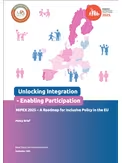
MIPEX 2025 EU update
Health Area
Area
3.2
Description

The Migrant Integration Policy Index (MIPEX) is a comparative tool that assesses migrant integration policies across 52 countries, including all EU Member States. The 2025 EU update provides country-by-country scores across eight policy areas: labour market mobility, family reunification, education, political participation, permanent residence, access to nationality, anti-discrimination, and health. The health dimension specifically addresses migrants' entitlement to healthcare including preventive services, the administrative requirements that gate access, and the availability of health mediators and interpretation services. MIPEX is used by the European Commission, OECD, and national governments as a benchmark for integration policy design.

Brief description
Migrant Integration Policy Index update comparing migrant integration policies across EU Member States, including health entitlement dimensions.
Keywords
MIPEX; migrant integration policy index; migrant health; entitlement; benchmarking; administrative barriers
Resource Title
MIPEX 2025 EU update [3.2]
Source
MIPEX, 2025
Topic
Migrant health; Legal entitlement
Tools & Frameworks
Studies and reports
Language
EN
Relevant actions
Action 2
Use it to…
Benchmark migrant health entitlement and identify administrative gates.
Where to look in this resource
The health strand, which scores entitlement and the administrative conditions attached to it across Member States.
Image
MIPEX 2025 EU update
Health Area
Area
2.1
Description

The Migrant Integration Policy Index (MIPEX) is a comparative tool that assesses migrant integration policies across 52 countries, including all EU Member States. The 2025 EU update provides country-by-country scores across eight policy areas: labour market mobility, family reunification, education, political participation, permanent residence, access to nationality, anti-discrimination, and health. The health dimension specifically addresses migrants' entitlement to healthcare including preventive services, the administrative requirements that gate access, and the availability of health mediators and interpretation services. MIPEX is used by the European Commission, OECD, and national governments as a benchmark for integration policy design.

Brief description
Migrant Integration Policy Index update comparing migrant integration policies across EU Member States, including health entitlement dimensions.
Keywords
MIPEX; migrant integration policy index; migrant health; entitlement; benchmarking; administrative barriers
Resource Title
MIPEX 2025 EU update [2.1]