Toolkit guide
Topic
ECD
Tools & Frameworks
Studies
Language
EN
Relevant actions
Action 2
Use it to…
understand the implications of early adversities to lifelong health and rational for investments into early years
Where to look in this resource
Pages 5-13 outline the evidence that early childhood experiences have a lifelong impact on health and wellbeing. Page 14-17 highlight key areas for policy intervention, such as parenting support and recommendations for primary health care.
Image
Connecting the Brain to the Rest of the Body: Early Childhood Development and Lifelong Health Are Deeply Intertwined
Area
1.1
Description

The paper synthesizes evidence from neuroscience, biology, and public health to explain how early experiences influence the development and interaction of multiple body systems, including the immune, metabolic, and stress response systems. It demonstrates how early adversity can contribute to preventable chronic diseases and mental health conditions later in life. The analysis links ECD directly to long‑term health outcomes and health system costs.

Brief description
This paper examines how early childhood development shapes lifelong physical and mental health through biological and psychosocial pathways.
Keywords
life-course health; toxic stress; brain development; chronic disease prevention; public health evidence
Resource Title
Connecting the Brain to the Rest of the Body: Early Childhood Development and Lifelong Health Are Deeply Intertwined
Topic
Early Detection
Tools & Frameworks
Tools & Frameworks
Language
EN
Relevant actions
Action 1
Use it to…
identify indicators related to developmental monitoring coverage, referral outcomes and follow-up
Where to look in this resource
Chapter 1 outlines the importance of developmental monitoring and the key role of the health sector, to support evidence building and identification of policy objectives. Chapter 3.1 identifies practices across countries in Europe and Central Asia, to allow identification of best practices. Chapter 3.2 - 3.6 outlines recommendations for practical implementation including selection of monitoring tools, financing and workforce as well as governance and evaluation.
Image
Monitoring children’s development through primary health care in Europe and Central Asia
Area
3.2
Description

The report examines how child development monitoring is integrated into primary health care services across countries in Europe and Central Asia. It reviews existing policies, practices, and tools used to assess developmental progress in early childhood, identifying both strengths and gaps. The publication emphasizes the importance of early detection, timely referral, and continuity of care within routine health services. It provides practical directions to strengthen systems, workforce capacity, and data use to support early childhood development.

Brief description
Report exploring how child development monitoring is integrated into primary health care services across countries in Europe and Central Asia. This resource supports policymakers in strengthening primary health care as a platform for early detection and intervention, helping prevent long‑term developmental and health inequities. It offers evidence‑based guidance to inform policy reforms, improve service integration, and enhance system responsiveness for young children and families.
Keywords
developmental monitoring; primary health care; referral pathways; surveillance systems; workforce development
Resource Title
Monitoring Children’s Development through Primary Health Care in Europe and Central Asia

Topic
Early Detection
Tools & Frameworks
Tools & Frameworks
Language
EN
Relevant actions
Action 1-4
Use it to…
understand and define specific roles of primary health care providers in using standardised developmental monitoring instruments, initiating referrals, and linking families to early childhood intervention services
Where to look in this resource
Chapter 1 outlines the importance of developmental monitoring and the key role of the health sector, to support evidence building and identification of policy objectives. Chapter 3.1 identifies practices across countries in Europe and Central Asia, to allow identification of best practices. Chapter 3.2 - 3.6 outlines recommendations for practical implementation including selection of monitoring tools, financing and workforce as well as governance and evaluation.
Image
Monitoring children’s development through primary health care in Europe and Central Asia
Area
2.3
Description

The report examines how child development monitoring is integrated into primary health care services across countries in Europe and Central Asia. It reviews existing policies, practices, and tools used to assess developmental progress in early childhood, identifying both strengths and gaps. The publication emphasizes the importance of early detection, timely referral, and continuity of care within routine health services. It provides practical directions to strengthen systems, workforce capacity, and data use to support early childhood development.

Brief description
Report exploring how child development monitoring is integrated into primary health care services across countries in Europe and Central Asia. This resource supports policymakers in strengthening primary health care as a platform for early detection and intervention, helping prevent long‑term developmental and health inequities. It offers evidence‑based guidance to inform policy reforms, improve service integration, and enhance system responsiveness for young children and families.
Keywords
developmental monitoring; primary health care; referral pathways; surveillance systems; workforce development
Resource Title
Monitoring Children’s Development through Primary Health Care in Europe and Central Asia

Topic
Early Detection
Tools & Frameworks
Tools & Frameworks
Language
EN
Use it to…
identify best practices to integrate developmental monitoring into primary health care systems
Where to look in this resource
Chapter 1 outlines the importance of developmental monitoring and the key role of the health sector, to support evidence building and identification of policy objectives. Chapter 3.1 identifies practices across countries in Europe and Central Asia, to allow identification of best practices. Chapter 3.2 - 3.6 outlines recommendations for practical implementation including selection of monitoring tools, financing and workforce as well as governance and evaluation.
Image
Monitoring children’s development through primary health care in Europe and Central Asia
Area
2.1
Description

The report examines how child development monitoring is integrated into primary health care services across countries in Europe and Central Asia. It reviews existing policies, practices, and tools used to assess developmental progress in early childhood, identifying both strengths and gaps. The publication emphasizes the importance of early detection, timely referral, and continuity of care within routine health services. It provides practical directions to strengthen systems, workforce capacity, and data use to support early childhood development.

Brief description
Report exploring how child development monitoring is integrated into primary health care services across countries in Europe and Central Asia. This resource supports policymakers in strengthening primary health care as a platform for early detection and intervention, helping prevent long‑term developmental and health inequities. It offers evidence‑based guidance to inform policy reforms, improve service integration, and enhance system responsiveness for young children and families.
Keywords
developmental monitoring; primary health care; referral pathways; surveillance systems; workforce development
Resource Title
Monitoring Children’s Development through Primary Health Care in Europe and Central Asia
Topic
Early Detection
Tools & Frameworks
Tools & Frameworks
Language
EN
Use it to…
can be used to inform the introduction of developmental monitoring as part of routine health service provision
Where to look in this resource
Chapter 1 outlines the importance of developmental monitoring and the key role of the health sector, to support evidence building and identification of policy objectives. Chapter 3.1 identifies practices across countries in Europe and Central Asia, to allow identification of best practices. Chapter 3.2 - 3.6 outlines recommendations for practical implementation including selection of monitoring tools, financing and workforce as well as governance and evaluation.
Image
Monitoring children’s development through primary health care in Europe and Central Asia
Area
1.3
Description

The report examines how child development monitoring is integrated into primary health care services across countries in Europe and Central Asia. It reviews existing policies, practices, and tools used to assess developmental progress in early childhood, identifying both strengths and gaps. The publication emphasizes the importance of early detection, timely referral, and continuity of care within routine health services. It provides practical directions to strengthen systems, workforce capacity, and data use to support early childhood development.

Brief description
Report exploring how child development monitoring is integrated into primary health care services across countries in Europe and Central Asia. This resource supports policymakers in strengthening primary health care as a platform for early detection and intervention, helping prevent long‑term developmental and health inequities. It offers evidence‑based guidance to inform policy reforms, improve service integration, and enhance system responsiveness for young children and families.
Keywords
developmental monitoring; primary health care; referral pathways; surveillance systems; workforce development
Resource Title
Monitoring children’s development through primary health care in Europe and Central Asia
Topic
Early Detection
Tools & Frameworks
Tools & Frameworks
Language
EN
Relevant actions
Action 3
Use it to…
assess readiness of primary health care systems to provide effective developmental monitoring and facilitate appropriate support to children at risk of developmental difficulties.
Where to look in this resource
Chapter 1 outlines the importance of developmental monitoring and the key role of the health sector, to support evidence building and identification of policy objectives. Chapter 3.1 identifies practices across countries in Europe and Central Asia, to allow identification of best practices. Chapter 3.2 - 3.6 outlines recommendations for practical implementation including selection of monitoring tools, financing and workforce as well as governance and evaluation.
Image
Monitoring children’s development through primary health care in Europe and Central Asia
Area
1.1
Description

The report examines how child development monitoring is integrated into primary health care services across countries in Europe and Central Asia. It reviews existing policies, practices, and tools used to assess developmental progress in early childhood, identifying both strengths and gaps. The publication emphasizes the importance of early detection, timely referral, and continuity of care within routine health services. It provides practical directions to strengthen systems, workforce capacity, and data use to support early childhood development.

Brief description
Report exploring how child development monitoring is integrated into primary health care services across countries in Europe and Central Asia. This resource supports policymakers in strengthening primary health care as a platform for early detection and intervention, helping prevent long‑term developmental and health inequities. It offers evidence‑based guidance to inform policy reforms, improve service integration, and enhance system responsiveness for young children and families.
Keywords
developmental monitoring; primary health care; referral pathways; surveillance systems; workforce development
Resource Title
Monitoring Children’s Development through Primary Health Care in Europe and Central Asia
Topic
Early Detection
Tools & Frameworks
Studies
Language
EN
Relevant actions
Action 4
Use it to…
understand how disruptions to health services can lead to widespread missed opportunities for early detection
Where to look in this resource
Highlights how disruptions to health services can lead to widespread missed opportunities for early detection, strengthening the case for resilient system design and the need for intervention
Image
Missed opportunities: The unknown impact of the COVID-19 pandemic on early childhood development in the WHO European region
Area
1.1
Description

This report explores the largely unmeasured consequences of the COVID‑19 pandemic on early childhood development in the WHO European Region. It reviews disruptions to essential services such as health care, early learning, childcare, and family support, as well as increased stressors on caregivers and households. The analysis highlights significant data gaps and missed opportunities to monitor, protect, and prioritize young children’s development during crisis response and recovery. It calls for stronger systems, better data, and child‑centred policies to mitigate long‑term developmental and social impacts.

Brief description
Missed opportunities examines how the COVID‑19 pandemic has affected early childhood development across the WHO European Region, highlighting gaps in evidence and response. The report underscores concerns about the hidden and long‑term impacts on young children and families.
Keywords
pandemic impact; service disruption; health inequalities; data gaps; system resilience
Resource Title
Missed Opportunities: Impact of COVID-19 on ECD in the WHO European Region
Topic
Early Detection
Tools & Frameworks
Studies
Language
EN
Use it to…
use recommendations to identify focus areas for intervention
Where to look in this resource
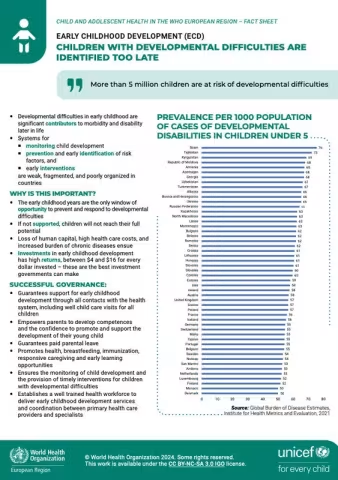
The factsheet highlights the prevalence of developmental difficulties, offering evidence to support the case for strong ECD policies. Recommendations are summarised for interventions such as parental support, workforce training and developmental monitoring, to help focus areas for intervention.
Image
ECD Factsheet on Developmental Difficulties
Area
1.3
Description

The ECD Factsheet synthesizes key evidence and supports the importance of early detection. The factsheet presents data and messages in a clear, accessible format, making complex evidence easy to understand. It is designed for quick reference by decision‑makers, practitioners, and partners.

Brief description
The ECD Factsheet provides a concise overview of the importance of early detection of developmental difficulties. It presents essential facts and messages to support awareness and advocacy for early detection.
Keywords
advocacy resource; developmental outcomes; risk factors; evidence synthesis; policy messaging
Resource Title
ECD factsheet on developmental difficulties
Topic
Early Detection
Tools & Frameworks
Studies
Language
EN
Relevant actions
Action 4
Use it to…
understand prevalence of developmental difficulties, key challenges and system-level actions to enhance early detection of developmental risks
Where to look in this resource
The factsheet highlights the prevalence of developmental difficulties, offering evidence to support the case for strong ECD policies. Recommendations are summarised for interventions such as parental support, workforce training and developmental monitoring, to help focus areas for intervention.
Image
ECD Factsheet on Developmental Difficulties
Area
1.1
Description

The ECD Factsheet synthesizes key evidence and supports the importance of early detection. The factsheet presents data and messages in a clear, accessible format, making complex evidence easy to understand. It is designed for quick reference by decision‑makers, practitioners, and partners.

Brief description
The ECD Factsheet provides a concise overview of the importance of early detection of developmental difficulties. It presents essential facts and messages to support awareness and advocacy for early detection.
Keywords
advocacy resource; developmental outcomes; risk factors; evidence synthesis; policy messaging
Resource Title
ECD Factsheet on Developmental Surveillance
Topic
ECD
Tools & Frameworks
Best practices
Language
EN
Relevant actions
Actions 1-2
Use it to…
understand a “whole-of-government” strategy aligning different ministries around a common vision for early childhood, and a package of universal policies promoting healthy ECD
Where to look in this resource
Pages 21-27 outline the context and importance of supporting ECD, as well as the strategic vision. Objectives 1 and 2 set out approaches to parental support and the need for resources and services for parents. Objective 3 sets out the context and interventions to address inequalities related to poverty and discrimination. Objectives 4-6 highlight the need for healthcare interventions to support physical and mental health. Goal D (pages 104-115) sets out areas to consider for effective implementation, including governance, workforce and monitoring. Pages 117-122 set out specific actions for implementation, while pages 122-171 outline specific strategic actions across the objectives
Image
4_ECD
Area
2.2
Description

A Whole-of-Government 10-year strategy focused on supporting the development, health, and well-being of children from birth to age five and their families. The strategy is built on four main goals: strengthening families and communities, ensuring optimum physical and mental health, promoting positive play-based early learning, and creating an effective early childhood system.

Brief description
Ireland's First 5 strategy is a best practice example indicating how ECD can be addressed across the whole of government, including key areas for intervention and using a progressive universalism approach.
Country
Ireland
Keywords
whole-of-government; progressive universalism; family services; health equity; implementation planning
Pdf file
Resource Title
Ireland’s “First 5” Strategy